Industries — Aviation
Aircraft hangar floor coatings
A hangar floor fails differently from every other industrial floor. The traffic is comparatively gentle — tugs, dollies, the occasional jack point — but what lands on the surface is not. Jet fuel, phosphate-ester hydraulic fluid, de-icing glycol, solvents and cleaning agents all sit on the slab, and some of them dissolve coatings that would shrug off a forklift for twenty years.
That is why a hangar specification starts on the chemical-resistance page of the datasheet, not the abrasion page. Get that wrong and the floor softens, discolours and lifts around exactly the areas that see the most attention — under the engines, around the fuelling point, along the tow path.
What actually attacks the floor
Phosphate esters are the problem child
Most resin floors handle hydrocarbon fuel and mineral oil well. Phosphate-ester hydraulic fluids — the Skydrol family used across commercial aviation — are a different chemistry, and they are aggressive towards a range of coatings, sealants and paints that otherwise perform. A floor system chosen on general "chemical resistant" marketing language, without checking that specific line on the manufacturer's resistance chart, is a floor chosen on hope.
De-icing fluid is the seasonal one. Glycol-based fluids track in on wheels through the winter, pool in low spots and sit there. They are less aggressive than phosphate esters but they are persistent, and they find any pinhole or unsealed joint.
Then there is the mundane damage that gets overlooked: point loading from jack pads and engine stands, which can indent a soft or under-built floor permanently, and dropped tooling, which chips a brittle one. The build has to be tough without being brittle, and that is a system decision rather than a thickness decision.
Zoning the hangar
One hangar, three or four different floors
Specifying a single system wall to wall is the most common way to overspend on a hangar floor and still get it wrong. The demands are not uniform, so the build should not be either.
| Zone | Dominant demand | What that implies |
|---|---|---|
| Aircraft bay, under wings and engines | Fuel, hydraulic fluid, oil | Highest chemical resistance; light-reflective finish helps inspection |
| Tow path and door threshold | Wheel traffic, grit, water and de-icer ingress | Heavier build, aggregate broadcast, sealed joints |
| Fuelling and avionics areas | Static discharge risk | Conductive or dissipative build, grounded and tested |
| Stores, workshop and walkways | General wear, housekeeping | Standard industrial build; colour-coded for wayfinding |
Zone boundaries are set on site with the operator, because they follow how the hangar is actually used rather than the drawing.
Where a static-control zone is specified, it only works as a system — conductive primer, a grounding network tied to building earth, and verification after installation. A dissipative topcoat over an ordinary primer, ungrounded, measures fine on the datasheet and does nothing on the floor. That work sits alongside our industrial floor coatings service.
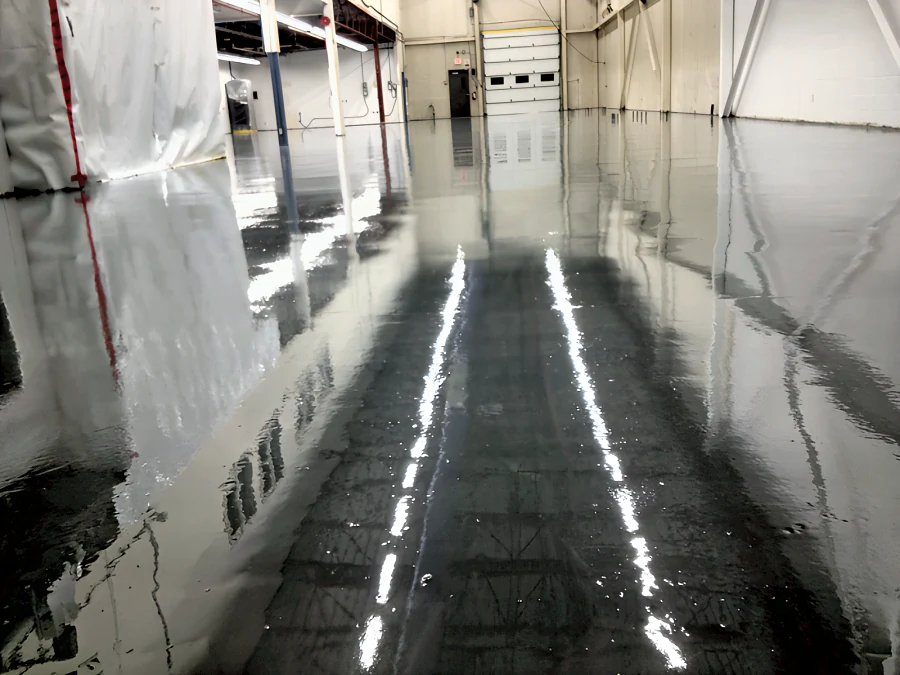
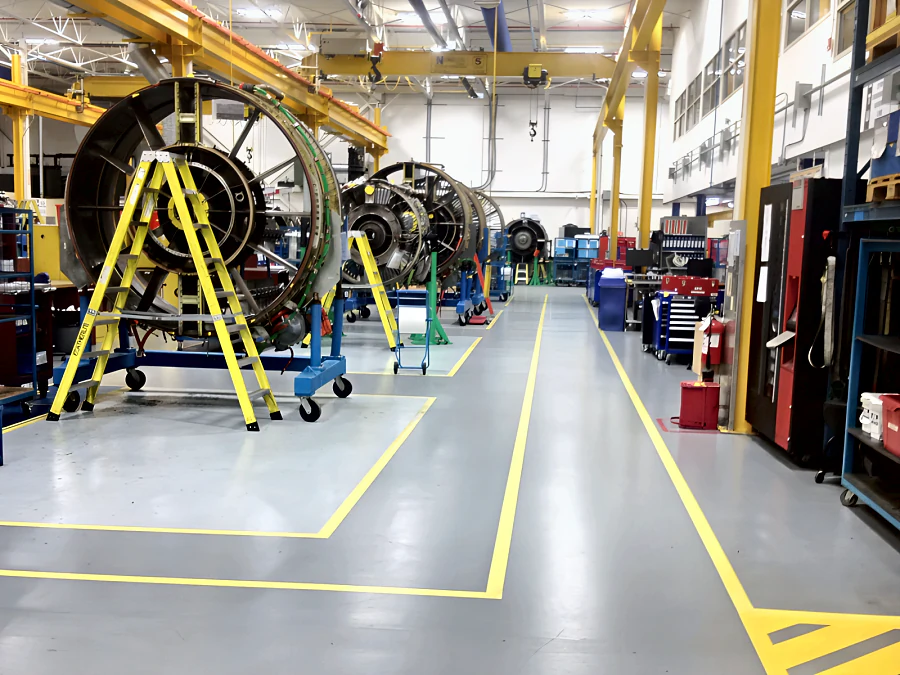
MTU Maintenance Canada, Building 2, Richmond, 2013: the high-gloss grey coat freshly laid, with the plastic containment still up (left), and the engine shop in service on the finished floor, engines on their stands and the aisles marked out in yellow (right). More on the Richmond page.
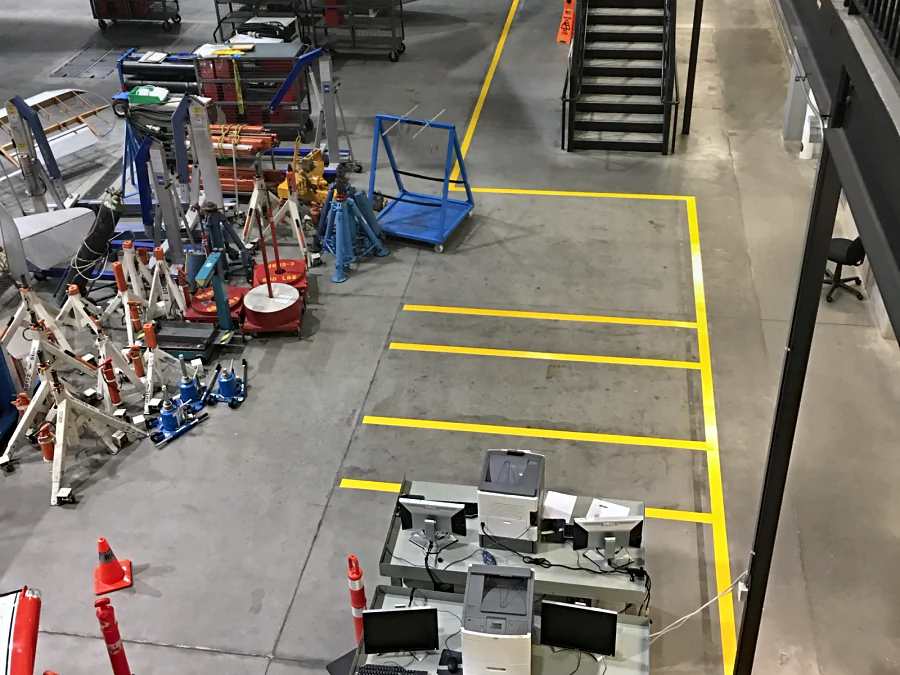
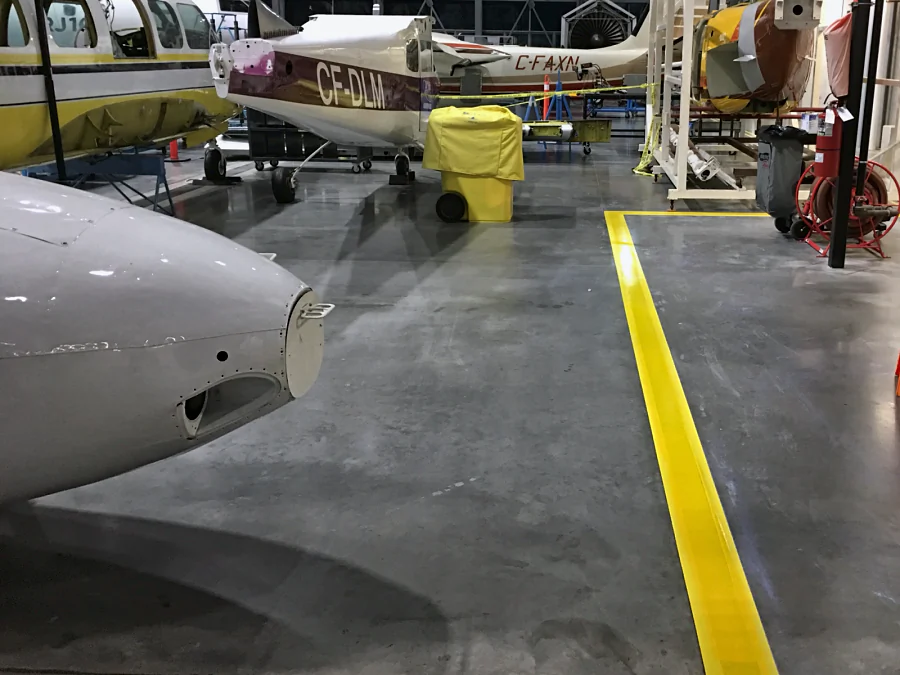
The BCIT Aerospace Technology Campus in Richmond: yellow urethane bay lines on the polished hangar floor by the stairs (left), and a bay line finished among the training aircraft (right). More on the projects page.
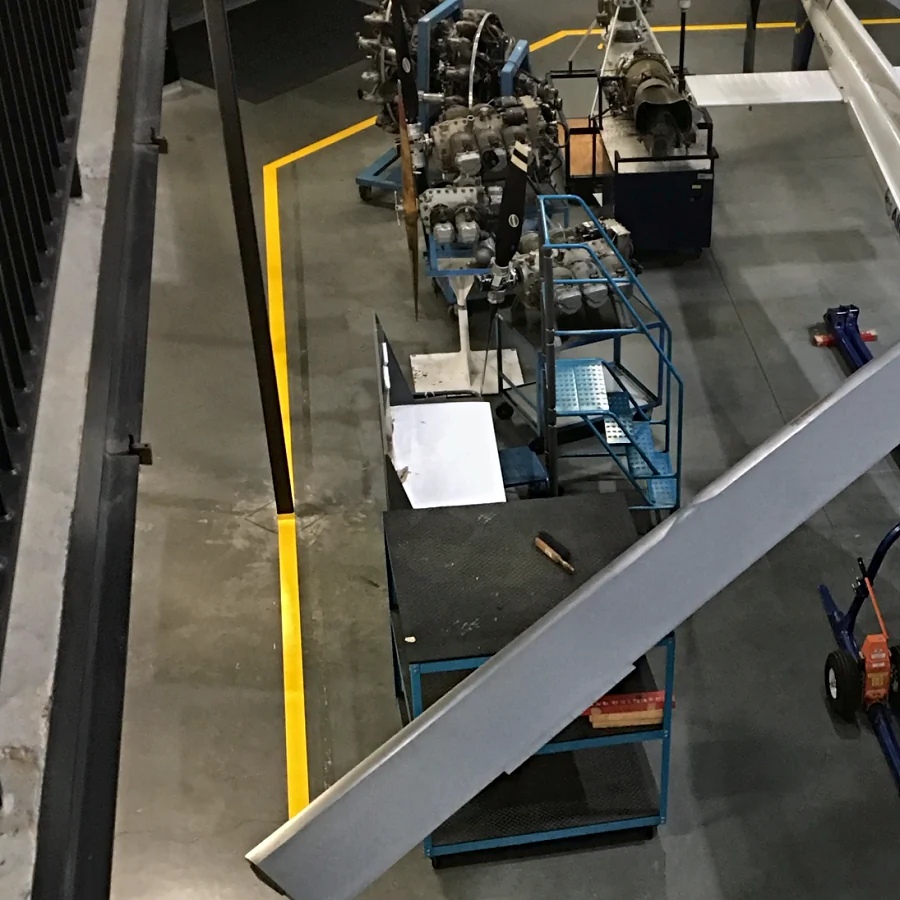
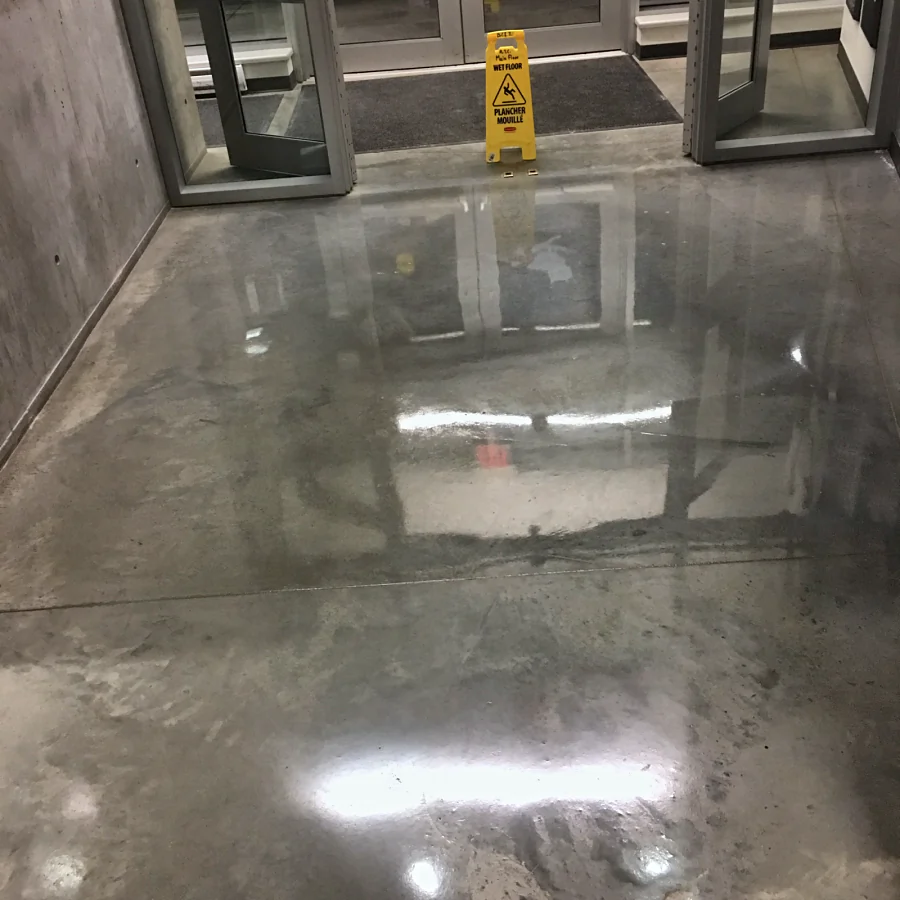
More from the same campus: the yellow walkway line round a bay of engines on their stands and a training helicopter (left), and the polished concrete at the entrance, the doors reflected in it (right).
Before anything is specified
The slab decides more than the resin does
Hangars are frequently large slab-on-grade pours, often decades old, sometimes without an effective vapour retarder beneath them. That makes moisture at depth the first measurement, not an afterthought — a chemically perfect system will still blister off a slab that is driving vapour into the bond line.
- Survey the slab and the spill map.
Existing coating, joint condition, spall and delamination, plus where fluid actually lands. The staining tells you more about the zoning than any drawing will.
- Moisture testing at depth.
In-situ relative humidity to ASTM F2170, or calcium chloride to ASTM F1869 where that is the datasheet's reference.
- Match the resistance chart to the fluids on site.
Named fluids, not categories. This is the step that separates a hangar specification from an industrial one.
- Prepare mechanically to the specified profile.
Shot blasting or diamond grinding to the CSP the system requires — see surface preparation. Fuel-contaminated concrete may need degreasing and, in bad cases, removal before any primer goes down.
- Phase around the maintenance calendar, then document.
Sections sized so aircraft can be repositioned rather than the hangar emptied, and a handover record of what was installed where, over what readings.
Questions we get asked
Hangar flooring FAQs
What makes a hangar floor different from a warehouse floor?
Chemistry, not weight. A warehouse floor is designed around abrasion from hard wheels. A hangar floor is designed around what gets spilled on it — jet fuel, phosphate-ester hydraulic fluid such as Skydrol, de-icing fluid, solvents and cleaners. Phosphate-ester fluids in particular attack coatings that handle fuel and oil without difficulty, so the specification is driven by the chemical resistance data on the datasheet rather than by the abrasion rating.
Do hangar floors need static control?
It depends on the operation. Fuelling zones, avionics benches and areas where electrostatic-sensitive components are handled are the usual cases for a conductive or dissipative build. Much of a hangar floor does not need it. Zoning the requirement rather than applying a static-control system across the whole slab is normally the sensible answer, because the conductive build costs more and needs a grounded network to work at all.
Can a hangar floor be coated without moving the aircraft out?
Usually the work is sectioned so part of the hangar stays operational, with aircraft repositioned between phases rather than the building emptied. The constraint is normally the cure schedule and the extent of the ventilation required, both of which are worked out at assessment against your maintenance calendar. Where the return-to-service window is very tight, a faster-curing chemistry can compress it.
What about line marking for aircraft positioning?
Nose-wheel guidance lines, tow paths, equipment zones, walkways and fire-lane hatching are applied as part of the system rather than painted on afterwards, so they wear with the floor instead of off it. Layouts can be revised at recoat, which matters when the fleet the hangar serves changes.
Keep reading
Related pages
Site assessments
Send us the slab. We'll tell you what it actually needs.
Photographs and a rough area are enough to start. We'll come out, test moisture, and scope it properly.
Main (604) 968-2040
Second (604) 230-0256
estimating@westpacificcoatings.com